Product Name:
Mouse Cysteine-rich angiogenic inducer 61 (CYR61) ELISA Kit
Cat.#:
JL28940
Regulatory Status:
Alternative:
CCN1; GIG1; IGFBP10; CCN family member 1; Insulin-like growth factor-binding protein 10
Detection Method:
ELISA
Assay Type:
Sandwich
Detection Range:
6.25-400pg/mL
Sensitivity:
3.1pg/mL
Specificity:
This kit recognizes Mouse CYR61 in samples. No significant cross-reactivity or interference between Mouse CYR61 and analogues was observed.
Sample Type:
Serum, plasma, tissue homogenate and other biological fluids
Assay Procedure:

Research Area:
Cell Biology
Size & Price: 
Product Datasheets
Instruction: 
| CYR61
Cysteine-rich protein 61, also known as Cyr61 or CCN family member 1 (CCN1), is a matricellular protein encoded by the Cyr61 gene. It belongs to the CCN family of secreted extracellular matrix (ECM)-associated signaling proteins (CCN intercellular signaling proteins). By interacting with cell surface integrin receptors and heparan sulfate proteoglycans, it regulates a broad range of cellular activities, including cell adhesion, migration, proliferation, differentiation, apoptosis, and senescence. During embryonic development, it is essential for cardiac septal morphogenesis, vascular formation, and vascular integrity in the placenta. In adulthood, it plays a significant role in inflammation and tissue repair, and has been implicated in chronic inflammation-related diseases, including rheumatoid arthritis, atherosclerosis, diabetic nephropathy and retinopathy, as well as various forms of cancer.| Typical data
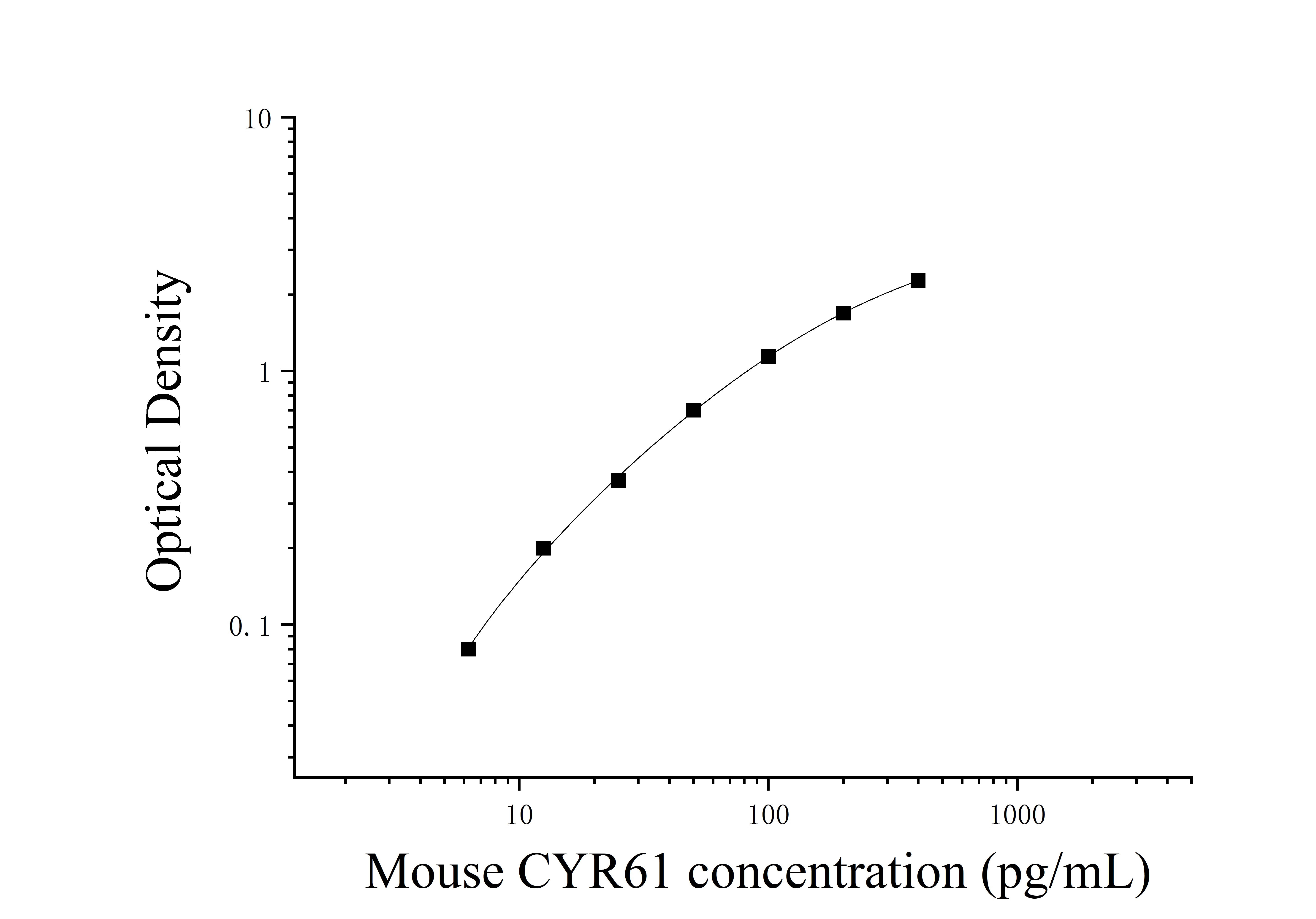
As the OD values of the standard curve may vary according to the conditions of the actual assay performance (e.g. operator, pipetting technique, wash technique or temperature effects), the operator should establish a standard curve for each test. Typical standard curve and data are provided below for reference only.| Concentration (pg/mL) | 400 | 200 | 100 | 50 | 25 | 12.5 | 6.25 | 0 |
| OD | 2.36 | 1.78 | 1.23 | 0.79 | 0.46 | 0.29 | 0.17 | 0.09 |
| Corrected OD | 2.27 | 1.69 | 1.14 | 0.7 | 0.37 | 0.2 | 0.08 | - |
| Repeatability
Intra-assay Precision (Precision within an assay):CV% < 10%; Inter-assay Precision (Precision between assays):CV% < 10%| Recovery
The recovery of Mouse CYR61 spiked at three different levels in samples throughout the range of the assay was evaluated in various matrices.| Sample Type | Range(%) | Average Recovery(%) |
| Serum(n=8) | 84-101 | 96 |
| Plasma(n=8) | 92-105 | 102 |
| Tissue Homogenates(n=8) | 96-108 | 105 |
| Linearity
Samples were spiked with high concentrations of Mouse CYR61 and diluted with Universal Diluent to produce samples with values within the range of the assay.| Serum(n=4) | Plasma(n=4) | Tissue Homogenates(n=4) | ||
| 1 : 2 | Range (%) | 84-95 | 85-96 | 90-110 |
| Average (%) | 91 | 93 | 96 | |
| 1 : 4 | Range (%) | 89-103 | 87-108 | 105-115 |
| Average (%) | 94 | 101 | 108 |
Related Product



Size
Quantity
Price ($)
48T
 1
1

360 / 360
96T
1
640 / 640